Men’s health and fertility: A key component of the family building journey
It’s time to shift the narrative around fertility. It’s time to talk about sperm. Addressing men’s fertility early in the family building journey is key — not just for family-building success, but because it often is correlated to other health risks, such as diabetes.
It’s time to move from a female-only focus to talk about the importance of men’s health.

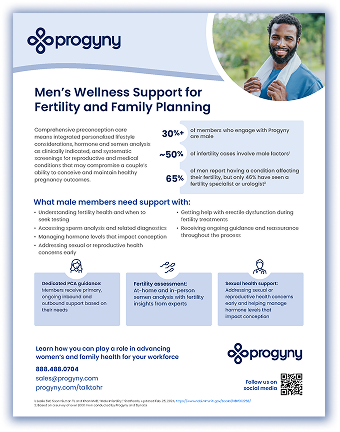
>30%
of members who engage with Progyny are male
~50%
of infertility cases involve male factors1
65%
of men trying to conceive report having a condition affecting their fertility, yet only 46% of those men have seen a fertility specialist or urologist2
1. Leslie SW, Soon-Sutton TL and Khan MAB, “Male Infertility,” StatPearls, updated Feb. 25, 2024, https://www.ncbi.nlm.nih.gov/books/NBK562258/ | 2. Progyny and Dynata survey of over 1,000 men, 2025
How Progyny supports men’s reproductive health
Progyny’s approach to men’s reproductive health goes beyond the basics – combining individualized lifestyle guidance, nutrition education, hormone and semen testing, and thorough screening for conditions that could impact fertility and pregnancy outcomes.
We work with employers to provide comprehensive and inclusive fertility and family building benefits. The goal of a healthy pregnancy and a healthy baby starts with supporting men as well as women on their reproductive journey.
Want to learn more? View our new men’s health research exploring experiences and views on fertility or get in touch.
How to get started
The journey toward more comprehensive men’s reproductive health options begins here. Check out these resources.
Why men’s health at work matters
Men’s health impacts every part of life, including how they show up at work — and employers have a powerful role to play in that. When employers prioritize men’s health, they help break down stigma, encourage early intervention, and create stronger, more engaged teams. The Detroit Pistons are leading by example, recognizing that supporting men’s well-being benefits everyone — at work and at home.

Need a men’s reproductive health 101? Check out these blogs
DocTalk: Cracking the code on male fertility
Men aren’t always the first to prioritize their health. In fact, the CDC found that men are 24% less likely than women to have visited a doctor in the past year. In this DocTalk video Dr. Michael Werner, Founder and Medical Director of Maze Sexual & Reproductive Health, breaks down male factor fertility.

For benefits leaders: The Progyny difference
-
Dedicated, expert support to proactively quarterback every journey
-
Largest, directly-credentialed and managed network of top providers (including reproductive urologists)
-
Whole person intervention of risks and needs from day one
-
Outcomes-focused programs that drive best practice care
-
Detailed and robust reporting to see value and impact of the benefit
Looking to bring family building benefits to your workplace?
Approaching your company about introducing fertility and family building benefits can be intimidating — but it doesn’t have to be. Discover advice and tips for starting the conversation with your HR team today.
Frequently asked questions on men’s reproductive health
What are the most common causes of male infertility?
There are many reasons why a man might have trouble getting someone pregnant. Sometimes the body doesn’t make enough sperm, the sperm doesn’t move well or aren’t shaped the right way. Health conditions like genetics, hormone problems, past infections, or injuries can also play a part. Lifestyle factors like smoking, drinking too much, using drugs, or being overweight can also lower sperm health.
How is male fertility tested?
The most common test is a semen analysis, which checks how much sperm there is, how well they move, and what they look like. A doctor might also do a blood test to check hormone levels or an ultrasound to look for any blockages or swelling in the testicles.
What are the signs of a fertility issue in men?
Most men don’t notice any clear signs until they have trouble conceiving. But sometimes there can be clues, such as:
- Trouble getting or keeping an erection
- Pain, swelling, or lumps in the testicles
- Less facial or body hair than usual
- Changes in semen (less fluid, unusual color, or thickness)
It’s good to be proactive and get tested early, regardless of symptom visibility.
Can male infertility be treated?
Yes — but the treatment depends on what’s causing the problem. Options might include:
- Medicine or hormone therapy to fix imbalances
- Fertility procedures like IVF or sperm injection
- Health and lifestyle changes to boost sperm quality
It’s also important to note that these treatments are not 100% guaranteed to “fix” infertility.
Can lifestyle changes improve men’s fertility?
Absolutely. Men can improve fertility by:
- Maintaining a healthy weight
- Exercising regularly but avoiding overtraining
- Limiting alcohol and quitting smoking (nicotine and cannabis)
- Reducing stress
- Eating a balanced diet rich in antioxidants (e.g., zinc, vitamin C, selenium)